
Our Philosophy
The Primary Classroom (2-5 years)
Children in the primary program possess what Dr. Montessori called the absorbent mind, the ability to absorb all aspects of one's culture and environment without effort or fatigue. As an aid to this period of the child's self-construction, individual work is encouraged. The following areas of activity cultivate the children's adaptation and ability to express and think with clarity:
- Practical Life exercises instill care for self, for others, and for the environment. Activities include many of the tasks children see as part of the daily routine in their home, such as preparing food and washing dishes, along with exercises of grace and courtesy. Through these tasks, children develop muscular coordination, enabling movement and the exploration of their surroundings. They learn to work at a task from beginning to end, and develop their powers of control and concentration.
- Sensorial materials serve as tools for development. Children build cognitive skills, and learn to order and classify impressions by touching, seeing, smelling, tasting, listening, and exploring the physical properties of their environment.
- Language development is vital to human development. The Montessori environment is rich in oral language opportunities, allowing the child to experience conversations, stories and poetry. The sandpaper letters help children link sound and symbol effortlessly, encouraging the development of written expression and reading skills. To further reading development, children are exposed to the study of grammar.
- Geography, Biology, Botany, Zoology, Art and Music are presented as extensions of the sensorial and language activities. Children learn about people and cultures in other countries with an attitude of respect and admiration. Through familiarity, children come to feel connected to the global human family. Lessons and experiences with nature inspire a reverence for all life. The comprehensive art and music programs give children every opportunity to enjoy a variety of creative activities, as well as gain knowledge of the great masters.
- Mathematics activities help children learn and understand the concepts of math by manipulating concrete materials. This work gives children a solid understanding of basic mathematical principles, prepares them for later abstract reasoning, and helps to develop problem-solving capabilities.


Our Approach to Discipline
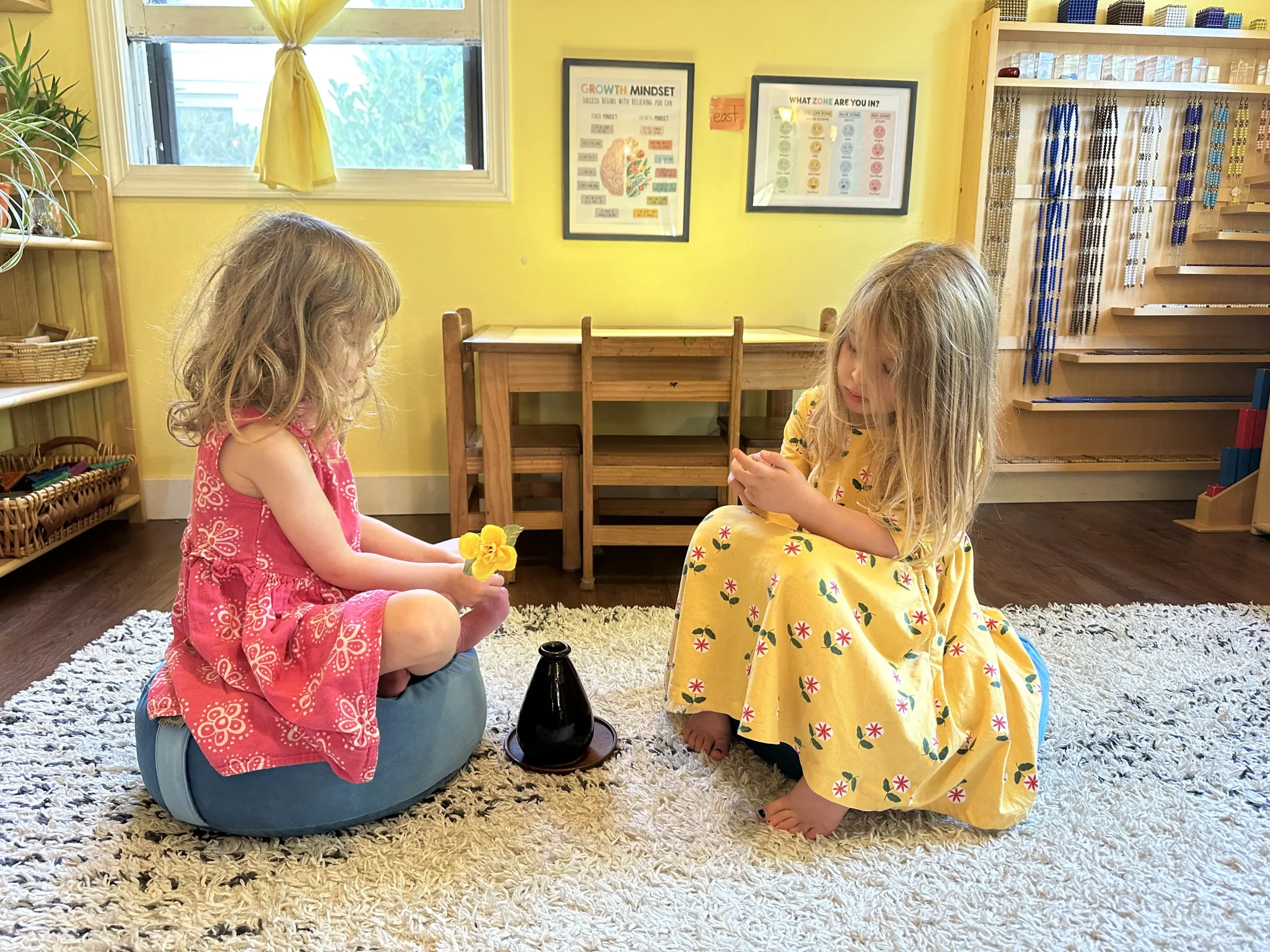
We believe that children do well if they can. Therefore we do everything that we can to assist a child in developing his/her own self-discipline. We offer activities and tools for developing the will and self-regulation. That said, everyone has a right to feel and be safe at school. Physical aggression is not acceptable under any circumstance. However, compassion is necessary for all concerned parties. A child acting out is a child who needs help just as much as the child acted upon.
We routinely suggest language and examples to encourage children to speak up for their needs and rights and to show respect for the rights of others. We view a course of destructive behavior as a demonstration that an obstacle is interfering with the natural flow of development. The Guide or Assistant interrupts the dangerous, hurtful, or disruptive behavior and begins to collaborate with the child to find a more appropriate behavior. The goal is always to make things right and offer the child an avenue back to a peaceful and purposeful activity.
Young children need our help to pause and reflect on their behavior. That is why we have adopted a “time-in” approach. It is an intentional technique with very positive, supportive and soothing outcomes. We talk with the child one-on-one and focus on his/her particular needs and feelings that may have contributed to the misbehavior. Only in extreme circumstances will a child be separated from other children, always in the company of an adult, until peace can be restored. Once the child is able, we will take the time to reflect back on what happened and what they could do differently next time.
Parents are always notified in instances of misbehavior that require more than a mild, routine redirection. We document these behaviors and take note of any patterns we may see. We work closely with families and whenever possible we use our Class Meeting and Positive Discipline Techniques to help a child who may be struggling. My staff and I are committed to this approach to help children with behavioral challenges to gain skills to help them succeed. We work closely with families to implement this approach for optimal success!
The History of Montessori
(abridged version!)
Maria Montessori, the founder of the Montessori Method, graduated from the medical school of the University of Rome in 1896, and was the first woman to practice medicine in Italy. As a physician, Dr. Montessori was very involved with the care of young children. Through scientific observation, she came to see how children interacted with one another, learned through the use of materials she provided, and went through specific phases of development. Her approach to education was developed based on her observations, in collaboration with her background in psychology and her belief in the education of children as a means to create a better society. She continued to observe children around the world, and found that the universal laws of development she had recognized were inherent to children of all races and cultures. The Montessori approach to education continues to be respected and practiced internationally
The Montessori Method
Please take ten minutes to watch this video if you are new to Montessori.